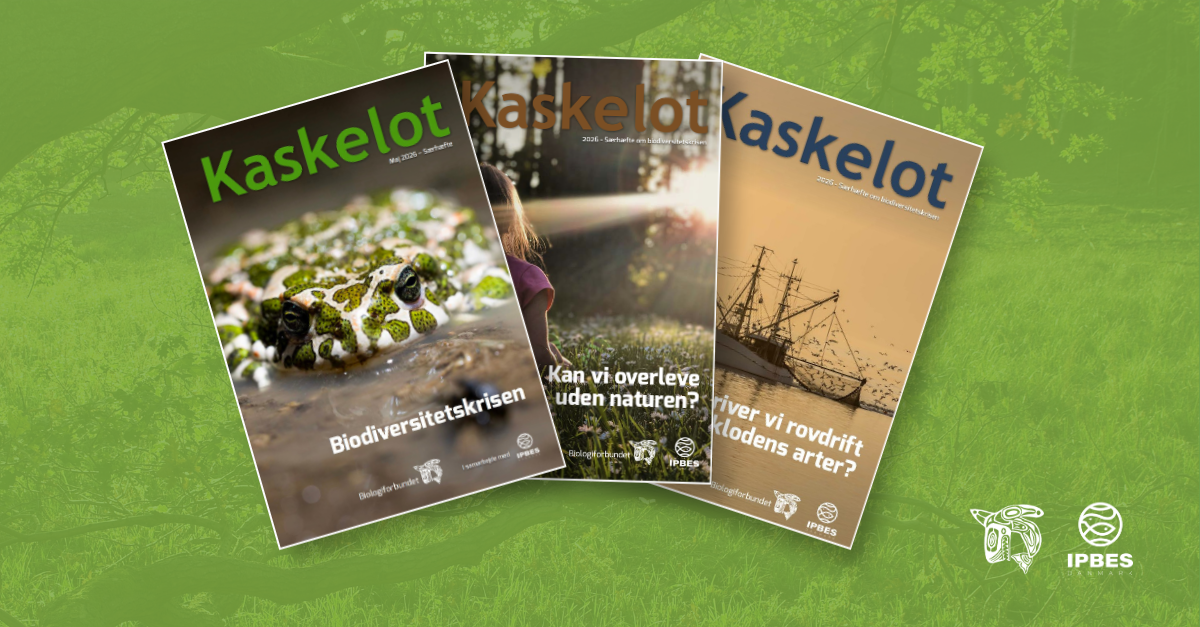
With 14 new feature articles, the biodiversity crisis is brought right into elementary school classrooms. These articles provide students and teachers with the very latest knowledge about the causes, consequences, and possible solutions to the biodiversity crisis.
How can we give students in grades 7–9 a solid and nuanced academic understanding of the biodiversity crisis without getting bogged down in doomsday scenarios or oversimplifying complex research and knowledge?
Achieving precisely that has been the goal behind the articles on the biodiversity crisis in a special issue of the journal *Kaskelot*, which was produced in collaboration between IPBES in Denmark and the Danish Biology Association.
The 14 thematic articles are designed for use in teaching subjects such as biology, geography, mathematics, and social studies in upper elementary and middle school, and have found their way onto the tables in the teachers’ lounges at every public school in the country! Yes, even the Danish-language schools in Schleswig and Holstein have received the booklet.
In addition to the printed version of the booklet being available in teachers’ lounges, the individual articles can also be downloaded here: https://sprogversion.hjemmesidehastighed.dk/undervisning/folkeskoler/undervisningsmaterialer
Research at Eye Level with Students
This special issue of Kaskelot on the biodiversity crisis brings together 14 articles that present the latest findings on the causes, consequences, and possible courses of action regarding the biodiversity crisis. The material is based on the the latest global biodiversity reports from the Intergovernmental Science-Policy Platform on Biodiversity and Ecosystem Services (IPBES), as well as new findings on European and Danish nature. The articles were written in collaboration between Lars Dinesen from IPBES in Denmark and Nanna Heidemann from the Danish Biology Association, tested by elementary school teachers, and quality-assured by leading researchers from IPBES’s Danish expert group. This means that the content is both academically top-notch and pedagogically well-thought-out. The foreword was written by Professor Katherine Richardson of the University of Copenhagen, Brian Ravnborg, chair of the Danish Biology Association, and Associate Professor Anders Barfod of Aarhus University, who served on the project’s steering committee. Marie Rubæk Holm created the illustrations.
The purpose of this material is to bring the latest scientific consensus on the biodiversity crisis directly to students, so that they are equipped to engage in discussions about the challenges that will primarily affect their own future. At the same time, the articles bridge the gap between global and Danish knowledge, and the issues are made tangible and relevant to students through examples and student assignments.
A key objective of these articles has been that they are directed specifically at students and can be read independently by them, while the assignments are completed with teacher support. The 14 articles can be used individually in class, as part of a thematic unit, or distributed among groups of students, who then present their work to one another. One, two, or three student assignments have been developed for each theme and article; these can generally be completed in pairs, with a class review session afterward.
“We’re hearing more and more about the biodiversity crisis, and for good reason. We must respect the many species with which we share the Earth—for their own sake, and because they will help ensure our ability to build a good life in the future. It is my hope that these articles will provide a new understanding of nature and inspire students to care for nature and live more sustainably.”
– Anders Sanchez Barfod, Associate Professor at the Department of Biology – Ecoinformatics and Biodiversity at Aarhus University
Clear structure – flexible application
The 14 feature articles are organized into four sections:
- Articles 1–6 provide insight into what the biodiversity crisis is, why we depend on nature, and shed light on its causes.
- Articles 7–8 focus on the connection to the climate crisis and provide insight into how we monitor biodiversity.
- Articles 9–13 address the value of nature, our consumption and eating habits, the impact of private companies and their dependence on nature, as well as the significance of our trade and ecological footprints.
- Article 14 addresses the question of how we can reverse the biodiversity crisis. The message is that it is possible, but that it is a difficult and significant challenge.
The articles are accompanied by videos that explain the biodiversity crisis: https://sprogversion.hjemmesidehastighed.dk/undervisning/folkeskoler/om-materialet/
Supports the Common Objectives for biology and strengthens practical skills
This material has been developed in accordance with the biology curriculum and the Common Objectives for the subject. It therefore directly addresses the topics of sustainability, the environment, and global issues, and strengthens students’ ability to:
- interpret data and figures
- think critically and innovatively
- discuss scientific and societal dilemmas
- identify courses of action at the local and global levels
The use of digital devices is kept to a minimum, and the material can be used in mobile-free schools.
From Understanding the Crisis to Hope and Action
The biodiversity crisis is not a niche topic. It is a fundamental societal challenge that we and future generations must navigate, but that is precisely why it can seem overwhelming. That is why the articles focus on balancing the seriousness of the issue and the information presented with perspectives on concrete courses of action.
“The biodiversity crisis is at least as important as the climate crisis, and in many ways, it concerns me even more. That is why it is important that the new scientific understanding of our relationship with biodiversity is disseminated throughout society and becomes part of our shared culture—starting all the way back in elementary school. I believe and hope that both teachers and students will find these articles very valuable.”
– Katherine Richardson, Professor of Biological Oceanography at the Biodiversity Section of the Globe Institute, University of Copenhagen
The goal, therefore, is not merely to inform, but to develop students’ ability to take action and provide them with a well-considered and nuanced foundation of knowledge at a time when misinformation and “fake science” are rampant. The ambition is for students not only to understand the crisis but also to feel that they have the knowledge, language, and tools to participate in a discussion about possible courses of action, and to help give them hope and influence the future.
A national partnership with strong roots
This thematic booklet is the result of a collaboration between IPBES in Denmark and the Danish Biology Association, which publishes the journal *Kaskelot*. IPBES in Denmark has been responsible for prioritizing themes and developing the articles, as well as ensuring the scientific content and prioritization, while the Biology Association has been responsible for the pedagogical organization and development of student assignments so that they are appropriate for elementary school students.
The teaching materials were developed with a grant from the Aage V. Jensen Nature Foundation.