At the EU Presidency conference “Transformative Governance for Food Systems and Biodiversity,” IPBES in Denmark highlighted the key messages and findings of the Nexus report, as well as the connection between biodiversity and future food production.
On December 3, IPBES in Denmark participated in the EU Presidency conference “Transformative Governance for Food Systems and Biodiversity” at the University of Copenhagen. The conference was held in connection with Denmark assuming the presidency of the Council of the European Union in the second half of 2025 and brought together policymakers, researchers, and key stakeholders from across the EU with the shared goal of finding new paths toward a fair and green food system.
IPBES in Denmark participated as a co-organizer of the conference, and on the day of the event, IPBES perspectives were placed on the agenda, first through an opening address on the Nexus report by Paula Harrison, IPBES’s co-chair and lead author of that very global Nexus report, and then during IPBES in Denmark’s session titled “Biodiversity: Global and European Strategies and Regulations.”
The Nexus Report Set the Framework for Sustainable Food Systems
The conference began on December 3 with an opening session, during which selected speakers gave presentations that set the stage for the day’s program. In her presentation, Paula Harrison outlined the key points and messages from the global Nexus report (IPBES 2024).
Drawing on the report, she explained how climate change, biodiversity loss, food production, water quality, and health are not separate problems, but rather deeply interconnected global crises that all influence one another.
We cannot solve the climate, food, and biodiversity crises in isolation. They are inextricably linked and require integrated, transformative solutions.
– Paula Harrison
Harrison concluded his presentation by emphasizing that if current negative trends continue, they will have significant consequences for all so-called nexus elements. Conversely, holistic solutions that address the challenges as a whole can create positive future scenarios with improvements across all affected areas.
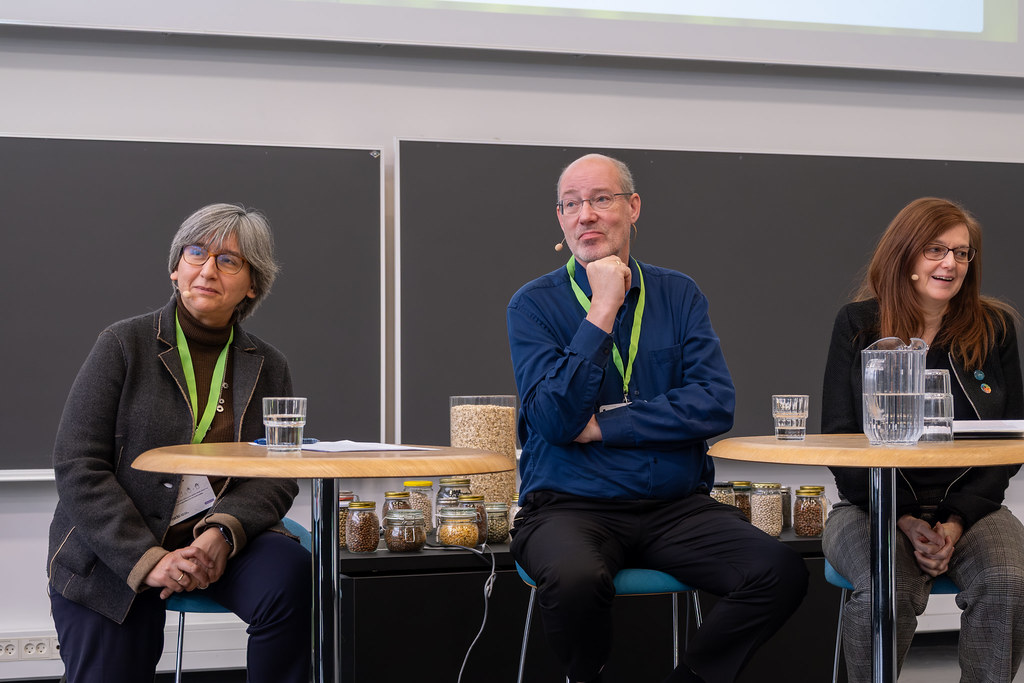
Later that day, she reiterated this message while participating in the session “Biodiversity: Global and European Strategies and Regulations,” organized by IPBES in Denmark. She participated alongside Carsten Rahbek, a professor at the University of Copenhagen and chair of IPBES in Denmark, and Alexandra Vakrou, Head of Unit at the European Commission’s Directorate-General for the Environment (DG ENV), both of whom endorsed the messages from the Nexus report.
The Nexus report can be read here: IPBES Reports – IPBES in DENMARK

Focus on solutions and challenges in global, European, and national contexts
The session “Biodiversity: Global and European Strategies and Regulations” focused on how biodiversity can be integrated into transformative governance models across global, European, and national levels. Participants discussed both existing biodiversity policies and strategies, as well as the barriers and opportunities that can influence their implementation in practice.
Professor Carsten Rahbek emphasized that over the past 10–15 years, significant progress has been made in integrating biodiversity into political and societal decision-making. Biodiversity is no longer viewed solely as nature and species conservation, but as something interconnected with agriculture, fisheries, and other sectors. At the same time, using Denmark’s Green Tripartite as an example, he pointed out that there is still a significant gap between political ambitions and a real understanding of the actual interconnections and their effects:
So if we look at the Danish example, we have the tripartite system. I hear that some people are praising Denmark for suddenly doing a lot of things, but they’re overlooking the fact that the way we subsidize agriculture and our fishing industry is actually causing tremendous problems. So the problems in Denmark are enormous, and yet we’re only doing a little bit.
– Carsten Rahbek
Overall, Rahbek’s point is that, although there are many well-intentioned initiatives, their impact on biodiversity remains limited. There is therefore a need for biologically realistic measures that take greater account of the specific connections between policy decisions and their actual consequences in nature.
Alexandra Vakrou similarly highlighted the challenges of translating ambitious policy goals into concrete action at the European level. Among other things, she referred tothe EU’sNature Restoration Regulation, which requires member states to restore damaged terrestrial and marine ecosystems. The regulation stipulates that at least 20% of the EU’s terrestrial and marine areas must be restored by 2030, with the aim of strengthening biodiversity, combating climate change, and supporting food security across agricultural, forest, urban, and marine ecosystems.
Citing this regulation, Vakrou pointed out that although there is a concrete and ambitious regulatory framework for improving biodiversity, the transition is facing significant resistance. Among other things, the criticism centers on the fact that the stakeholders involved feel there are too many instruments and initiatives in play at the same time, and that the level of ambition set is considered by many to be too high.
So I think we now face a major challenge: how to implement it. And how to implement it in a meaningful way—and I think it’s not just about doing it in a meaningful way, but also in a realistic way.
– Alexandra Vakrou
In doing so, she pointed out that the key challenge moving forward will be to ensure an implementation that is both realistic and meaningful; An implementation that does not compromise on the necessary ambitions, but at the same time ensures broad involvement of the stakeholders who will translate the policy into concrete and effective results.
In closing, Paula Harrison summarized the session’s key points with this central message:
The time for siloed thinking is over. Solutions and options for action already exist to address all nexus elements: biodiversity, food production, water, health, and climate change. What we need is bold, integrated action.
– Paula Harrison
Both Paula Harrison’s presentation from the opening session and the IPBES in Denmark session, “Biodiversity: Global and European Strategies and Regulations,” were recorded live. They can be viewed or watched again here: Video recordings from the conference – University of Copenhagen