
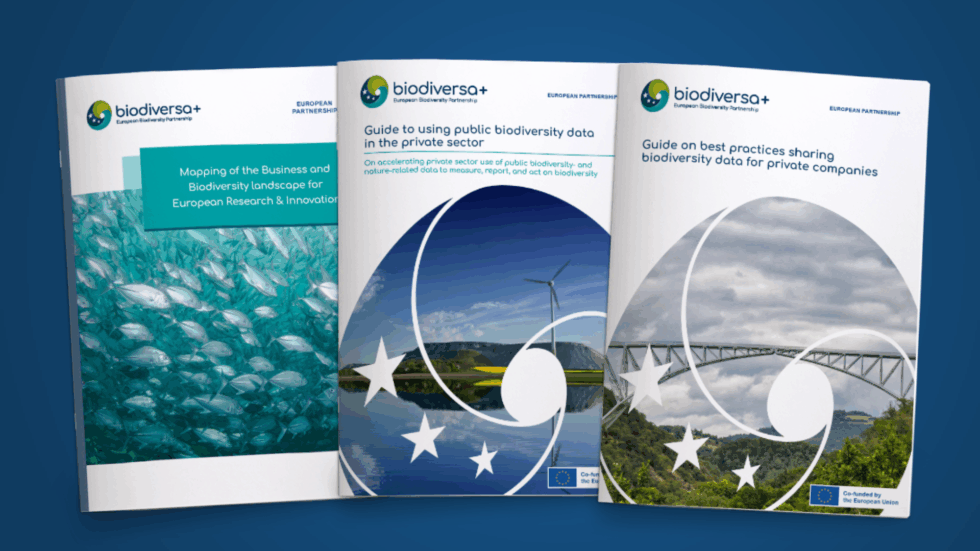
With just a few weeks to go before the upcoming12th IPBES Plenary on biodiversity in the business sector, Biodiversa+ is releasing a “toolkit” with three new reports designed to help companies turn biodiversity data into action.
The role of the business community—and the private sector in particular—in the biodiversity crisis has received increasing attention in recent years, and biodiversity is now an indispensable concern for both companies and financial institutions.
This awareness has grown, in part, as a result of the adoption of the 2030 goals in the 2022 Kunming-Montreal Agreement and the new EU directive, the CSRD (Corporate Sustainability Reporting Directive), which sets requirements for companies’ sustainability reporting, including their impact on and dependence on nature and ecosystem services. As a result, companies are increasingly recognizing that biodiversity is no longer merely an ethical consideration, but a strategic business issue.
As expectations regarding reporting, risk management, and accountability continue to grow, companies are collecting more biodiversity data than ever before. But for many companies, this new data landscape is overwhelming, complex, and difficult to navigate, which is why much of the data they collect ends up being underutilized.
Only 0.7% of the datasets held by GBFI (the Global Biodiversity Information Facility) come from private companies, despite the significant impact they have on biodiversity and ecosystem services, and despite the extensive monitoring efforts they have actually implemented.
It is precisely this challenge that the Business & Biodiversity toolkit addresses by translating research-based knowledge into clear, action-oriented steps that companies can apply directly in their strategic and operational work.
A valuable addition to the upcoming IPBES plenary session
The three reports are being released this winter, a time when there is an especially strong focus on the role of biodiversity in the business world. Here in January, the World Economic Forum Annual Meeting was held (January 19–23), and in February, the 12th IPBES Plenary, where the adoption of the upcoming global consensus report, *Methodological Assessment of the Impact and Dependence of Business on Biodiversity and Nature’s Contributions to People*, will be discussed.
Read IPBES’s introductory brochure for the upcoming report here: IPBES Digital Assets
Biodiversa+ deliberately views its newly released toolkit as a supplement to the upcoming IPBES report. While the upcoming IPBES report aims to provide the first global scientific assessment of how businesses depend on and impact biodiversity, and what transformative change is needed, the three reports from Biodiversa+ will complement this by focusing on implementation: how biodiversity data is already being used by businesses, where barriers still exist, and how existing data can be mobilized more effectively (Biodiversa+, 2025).
Read Biodiversa+’s news article about the toolkit here: New reports show how biodiversity data can move business from commitment to action – Biodiversa+
Three reports with three key areas of focus
The reports in the Biodiversa+ toolkit help companies navigate both regulatory requirements, such as those under the CSRD, and voluntary frameworks, such as the one established by the TNFD (Task Force on Nature-related Financial Disclosures). At the same time, they also help shift the focus from risk mapping to informed decision-making regarding companies’ impacts, dependencies, and options for action when it comes to biodiversity.
The three reports are each organized around a specific thematic focus:
- “Mapping of the Business and Biodiversity Landscape for European Research & Innovation”
Provides an overview of key players, policies, and initiatives shaping the biodiversity agenda for the business sector—with a particular focus on Europe. - “Guide to Using Public Biodiversity Data in the Private Sector”
Provides practical guidance on how companies can identify, interpret, and use publicly available biodiversity data in risk assessments, strategic decision-making, and reporting. - “Guide on Best Practices for Sharing Biodiversity Data for Private Companies”
Presents a step-by-step approach to the responsible and effective sharing of corporate data, which promotes transparency, collaborative knowledge-building, and better decision-making across sectors.
Taken together, the reports emphasize that companies cannot simply operate in isolation when it comes to data collection. Improving biodiversity outcomes depends on clearer information flows, realistic use of available data, and collaboration across business, finance, research, and public policy.
The toolkit combines expertise in biodiversity science, corporate sustainability and regulation, data infrastructures, and policy analysis, and all three reports are based on case studies, expert interviews, and input from companies, researchers, and public sector actors.
The Business & Biodiversity Toolkitis freely available and offered at no cost to all companies that wish to translate biodiversity data into concrete action and contribute to a more nature-positive economy. You can find the toolkit and the individual reports here: The Biodiversa+ Business & Biodiversity Toolkit – Biodiversa+
The reports were published in collaboration with EY Denkstatt Bulgaria, the Danish Innovation Fund, KPMG Netherlands, the Naturalis Biodiversity Center and the University of Twente, and Lars Dinesen, coordinator of the Danish IPBES office, served as lead author of the first of the reports, “Mapping of the Business and Biodiversity Landscape for European Research & Innovation.”
Lars will also participate in the 12th IPBES Plenary, which will take place February 3–8, where he will represent the Danish IPBES delegation alongside Associate Professor Justine Grønbæk Pors from CBS. At the plenary session, IPBES members and experts from around the world will gather to discuss the “Biodiversity in Business” report ahead of its expected release on February 9.