Last week marked the start of work on a new IPBES expert opinion on transformative change. The expert opinion will build on the 2024 global IPBES report on the same topic and apply its key messages to a Danish context.
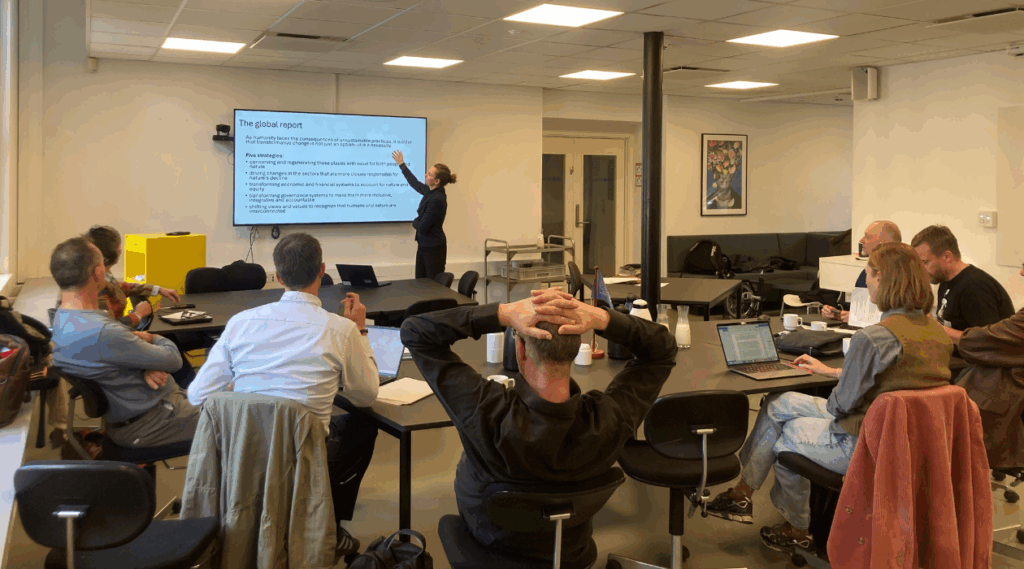
On Thursday, October 2, work began on yet another IPBES expert assessment when the Danish IPBES office, together with the two upcoming lead authors, Associate Professor Justine Grønbæk Pors from Copenhagen Business School and Professor Katherine Richardson from the University of Copenhagen, hosted the introductory workshop for the report.
The upcoming expert opinion will be based on the global consensus report *Assessment Report on the Underlying Causes of Biodiversity Loss and the Determinants of Transformative Change and Options for Achieving the 2050 Vision for Biodiversity*, also known as the *Transformative Change* report.
Learn more about IPBES’s global consensus reports
The workshop also drew on the symposium “Closer to Transformative Change—Systemic Solutions to the Biodiversity Crisis,” which was held in February in collaboration with Copenhagen Business School and explored how we in Denmark can bring about transformative change.
Learn more about the symposium
The Global Transformative Change Report examines the underlying causes of biodiversity loss and outlines the actions needed to achieve the UN’s 2050 vision for biodiversity. The report emphasizes and addresses the need to bring about transformative change in order to reverse the biodiversity crisis.
IPBES defines transformative change as:
A fundamental, system-wide reorganization encompassing technological, economic, and social factors, including paradigms, goals, and values.
– IPBES (2019)
Both lead authors of the upcoming expert opinion agree that it is both extremely important and relevant to have this particular report adapted to a Danish context. Associate Professor Justine Grønbæk Pors explains it this way:
The global IPBES report highlights the importance of taking a systemic approach to biodiversity. It emphasizes the importance of conceiving and implementing change in ways that involve legislation, regulation, valuation, understandings of nature, behavior, and issues of justice and equality. This understanding of interconnections and relationships is also of crucial importance in a Danish context.
– Associate Professor Justine Grønbæk Pors, CBS
Professor Katherine Richardson concurs and places the report in the context of a broader global movement that addresses our realization of the need to drastically change our behavior and our relationship with the world around us.
There is a global “movement” underway in which humanity is beginning to realize that civilization, as we know it, cannot continue to thrive unless we actively manage our relationship with the world around us. This requires us to develop a vision for where we want to go and how we want to allocate the Earth’s resources, including biodiversity—and this applies not only among us humans but also among all other living organisms. The Sustainable Development Goals and the CBD present this vision—now we must consciously change and transform society so that we can achieve it.
She continues, providing a detailed explanation of the importance of the work on the Danish expert opinion:
I believe it is important that we disseminate the report and its contents and adapt them to a Danish context, because Denmark—as part of the global community—must also be part of this “movement” or “journey,” and our expert opinion can help more people understand that preserving biodiversity requires much more than simply creating a “red list” of threatened species. It requires not only a change in the way we think, but also changes in our economic systems, our legislation, and our behavior.
– Professor Katherine Richardson, University of Copenhagen
The workshop was attended by researchers and experts from several of IPBES’s partner universities in Denmark, notably from Copenhagen Business School, the University of Copenhagen, and Aarhus University. In its final form, the expert report will bring together knowledge from a wide range of disciplines, and Justine Grønbæk Pors highlights this as a particular advantage.
The work on the expert report draws on a range of disciplines within the natural sciences, social sciences, and humanities. As such, it offers a unique contribution to policy work that does not compartmentalize issues into disciplinary silos. By documenting the need for transformative change and identifying options for action, the report can inform policy discussions on how we can move toward a greener society.
– Associate Professor Justine Grønbæk Pors, CBS
The expert report on transformative change will be the fourth published by IPBES in Denmark. Previous publications include *The Value of Biodiversity* ( 2025), *Restoring Marine Biodiversity and the Sustainable Use of Marine Resources* (2021), and *Restoring Biodiversity and Ecosystems* (2020).
The expert opinions can be found and downloaded as PDF files here: Danish IPBES Publications