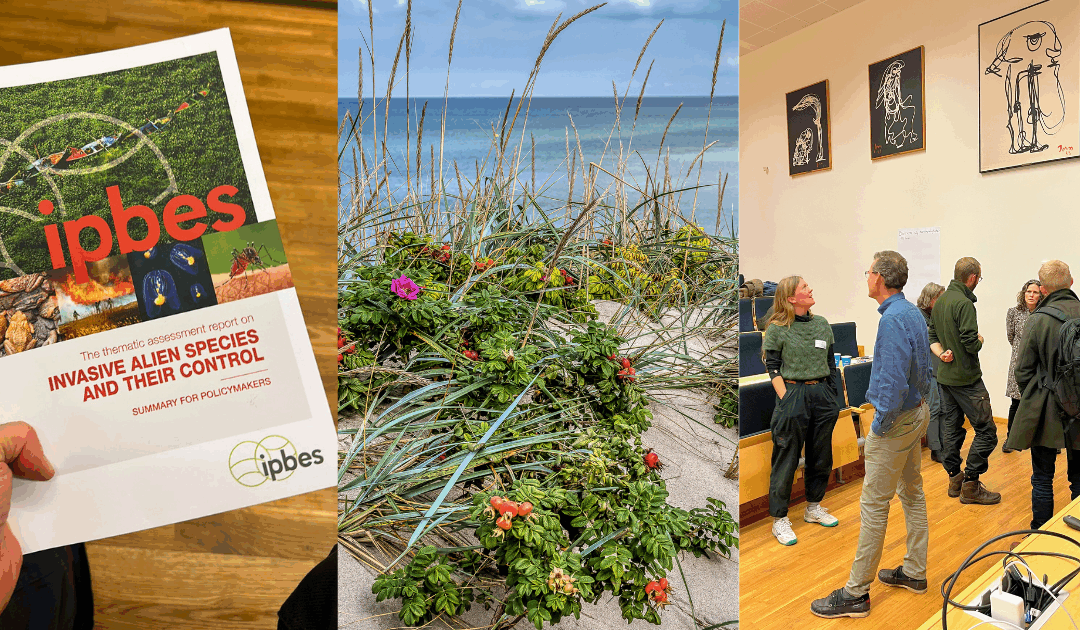
New editions of IPBES in Denmark’s educational workbooks on the biodiversity crisis will be available this summer, featuring, among other things, new insights into Danish and global biodiversity as well as planetary boundaries.
Most people have heard of the biodiversity crisis, but very few have a comprehensive understanding of the crisis’s scope, causes, and—not least—its solutions. With the goal of putting this topic on the agenda in Danish high schools, a series of educational materials was developed and published by IPBES in Denmark with support from the Aage V. Jensen Nature Foundation in January 2022.
The materials, which consist of three workbooks, a teacher’s guide, and a series of videos, have been widely distributed since their release; the workbooks have been downloaded by approximately 100 high schools, approximately 130 other institutions, and well over 100 individuals.
The materials are currently undergoing a major update, with new editions to be published in June, when the three booklets on the biodiversity crisis will be updated with the latest findings. For example, the updates will affect the section on the so-called planetary boundaries in Booklet 2.
In the new edition, all nine planetary boundaries have now been added and updated based on a new research study led by Professor Katherine Richardson of the University of Copenhagen, which was published in the fall of 2023 amid significant global media attention. Six of the nine planetary boundaries are assessed as having been exceeded. Therefore, it also makes sense, for example, to include information about the new targets from the 2022 Montreal Biodiversity Summit in the new booklets.
In addition to the content being updated with new information, all the booklets are getting a visual makeover from Grafisk Produktion in Odense, featuring new illustrations by Marie Rubæk Holm.
Solutions and Courses of Action Take Center Stage
The purpose of these workbooks is to ensure that Danish high school students gain a better understanding of the state of both Danish and global biodiversity and the associated ecosystem services. At the same time, the aim is to motivate students to engage in reflection and discussion about possible solutions to these challenges and courses of action.
The update therefore includes new information based on the global IPBES reports, three of which have been adopted since the teaching materials were first published.
In addition, a new set of global biodiversity targets was adopted in Montreal in December 2022, to be achieved by 2030, and the EU has also further developed requirements for private companies regarding the reporting and presentation of biodiversity accounts, including nature restoration and conservation.
At the national level, the Biodiversity Council has published two reports focused on Danish biodiversity, which, among other things, propose that Denmark meet and contribute equally with other countries toward the international goals set by the UN and the EU to reverse the biodiversity crisis.
The workbooks will be ready in June, when they can be downloaded fromthe IPBES in Denmark website and incorporated into the curriculum after summer break. The workbooks will also be presented at the Folkemødet on Bornholm in 2024.
The project also contributes to the Eksperimentarium’s exhibition on biodiversity and the biodiversity crisis in the form of video clips. The exhibition will run for the next five years under the title “Biodiversity—The Earth’s Diversity of Animals and Plants.”