
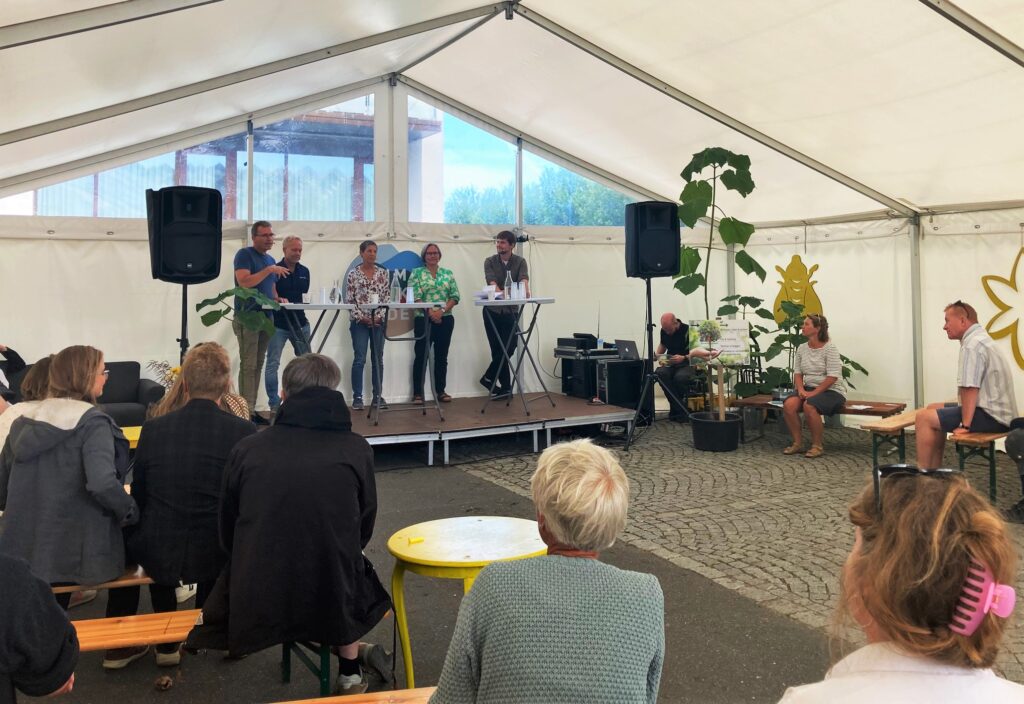
The importance of lowland areas for the climate and biodiversity was emphasized during the session on carbon-rich lowland soils organized by IPBES Denmark at the Climate People’s Assembly in Middelfart last week. Participants in the session included Inken Breum Larsen, Forest Manager at the Danish Nature Agency; Bettina Helle Jensen, Office Director at the Danish Environmental Protection Agency; Emil Haahr Vibild, Senior Officer at the Danish Agricultural Agency; and Jannik Seslef, Project Manager at Assens Municipality. Lars Dinesen from the Danish IPBES office moderated the session.
It is estimated that up to 20–25 percent of Denmark has been covered by bogs since the Ice Age. These former bogs were a central focus during the session at the Climate People’s Assembly, as bogs naturally have high water levels and unique plant life. However, today the vast majority have been drained and converted into meadows or fields through the use of drainage ditches, piping, and pumps.
Peatlands are important for the climate because, in short, they contain high levels of carbon that has accumulated in the peat over thousands of years. But when peatlands are drained, the carbon is oxidized and released into the atmosphere as the greenhouse gas carbon dioxide. For nature, peatlands are also important habitats for many animals, plants, and mosses.
Globally, peatlands store twice as much carbon as the world’s forests—in a much smaller area. The world’s drained peatlands account for approximately 15 percent of the total, but release more than five times as much carbon as the remaining peatlands sequester during the same period. In Denmark, for example, 40 percent of agricultural emissions come from drained peatlands, and therefore 20 percent of Denmark’s reduction target can be achieved by stopping emissions from drained peatlands.
Step it up to reach the goal
If the Paris Agreement’s goal of net-zero emissions is to be achieved by 2050, water must be applied to nearly all carbon-rich lowland soils worldwide—including cultivated land. In Denmark, 171,000 hectares have been identified. This figure represents four percent of Denmark’s total land area and seven percent of its agricultural land. According to a broad political agreement from 2021, 100,000 hectares are to be flooded by 2030.
Although there was some optimism among the panelists at the Climate People’s Assembly, it was also clear that we need to shift into a whole new gear to reach the goal. The discussion with the audience in the tent in Middelfart covered topics such as casual conversation, land distribution and expropriation—for example, when implementing road and wind turbine projects—as well as uniform conditions for the state and municipalities when drawing on the toolbox for solutions. Finally, the importance of inviting landowners at an early stage to discuss potential solutions was emphasized.
This work also contributes to the EU’s biodiversity strategy, under which member states such as Denmark are required to help ensure that 30 percent of the EU’s land area is designated for biodiversity as a primary objective through, for example, restoration and the use of nature-based solutions.
Thank you to the panelists for their constructive contributions to the debate, and thank you to all the audience members who stopped by the Gul Scene at this year’s Climate People’s Assembly.
Photo: Viggo Lind.